5 Things to Know About Feed Management
The term Feed Management is an English neologism referring to the management of offers and product catalogues for e-commerce businesses. This method serves two key objectives for e-commerce businesses:
- Driving traffic to websites via product price comparison services and affiliates
- Distributing offers on marketplaces.
This method is based on centralising data in order to distribute product offers through dedicated marketing channels, while maintaining control over how they are built and developed.
Here, we review the main principles of Feed Management, a genuine offer strategy covering the creation and launch of product feeds, as well as optimisation, monitoring and, of course, return on investment.
The Product Catalogue is THE key to online advertising
Feedback from major e-commerce players is clear: product feed management is the primary method used to support traffic and revenue acquisition. It is therefore essential to take good care of it!
Feed Management lies at the heart of any marketing strategy aimed at distributing e-commerce offers. It refers to working on the offer by developing a feed and optimising it in order to achieve the best possible distribution and analysis objectives.
1. The Product Feed
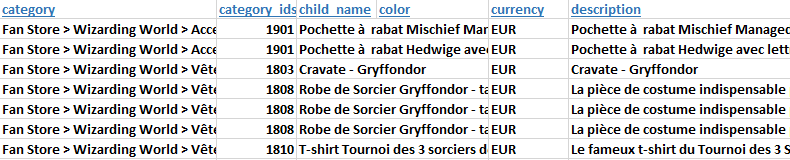
Example of a product feed format
A product feed simply consists of rows, each representing a commercial offer. The formats may vary, but it is fairly similar to an Excel file.
This is the source that will allow all the information to be distributed.

Typical formats for your product catalogues
Feed Management relies on providing information that is as complete, high-quality and up to date as possible in order to distribute quality content and increase visibility.
2. Feed management solutions
Feed Management naturally involves configuration and catalogue optimisation, and e-commerce businesses have two options:
- Choose a feed aggregator (feed management solution):
- This tool makes it possible to centralise product catalogues, optimisations and all feeds intended for dedicated marketing channels. It also helps avoid additional internal development.
- Develop your own feed and manage optimisations directly:
- This option is suitable for smaller feeds that can be modified directly.
As you will have understood, the larger the product catalogue, the more the first option is recommended. These aggregators bring together a number of features that make it possible to manage all product feeds centrally.
This makes it possible to optimise and control the overall distribution of different product catalogues to price comparison services, marketplaces and affiliate platforms.
3. The offer deployment strategy
A feed must be unique, adaptable and flexible.
Once the objectives have been defined and the marketing strategy established, it is time to apply it to the offer. This stage lies at the heart of Feed Management: adapting the offer to match demand.
The aim is to adapt as closely as possible to the requirements of the channel on which the offer will be distributed.
This is the optimisation stage: content, titles, shipping costs. Everything can be adapted!
4. Daily offer management and monitoring
Once product campaigns have been launched on price comparison services or offers published on marketplaces, no one is immune to seasonality, different promotional periods or changes in the technical specifications required by a distribution platform.
Feed Management does not only come into play when deploying the offer, but throughout the different commercial periods as well. This is the stage of offer management and monitoring.
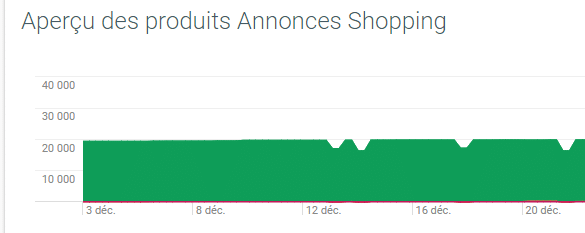
Feed graph in Google Merchant Center linked to distribution on Google Shopping
The more stable a feed is, the greater the chances of gaining visibility and displaying high-quality ads. Feed Management therefore contributes to stabilising the offer in order to achieve the best possible product distribution or integration rate.
The work is based on creating, deploying and maintaining high-quality content in order to support the reputation of e-commerce businesses through content distribution and paid campaigns.
5. Track and analyse performance more precisely.
The ads are live:
- What are the results in terms of traffic acquisition?
- What share of sales comes from marketplaces?
These are questions that Feed Management can help answer by providing clearer visibility into traffic and sales performance.
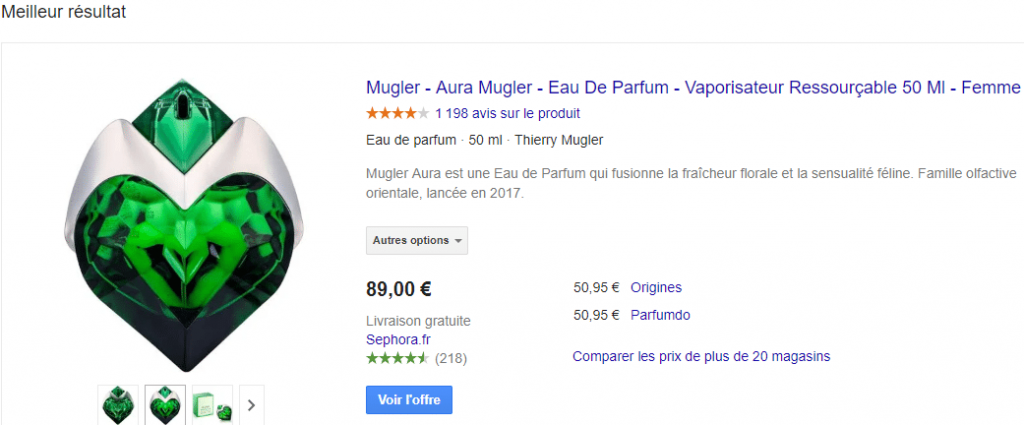
Example of a Shopping ad / Feed Manager
Tracking offer performance becomes easier. It is possible to track and analyse sales or traffic acquisition using certain methods.
For example:
- Add labels to segment campaigns more precisely
- Add tracking URLs to ads in order to improve the quality of the analysis
These solutions, by combining Feed Management with performance analysis, provide an ROI-focused view of the work carried out and make it possible to analyse all the relevant KPIs. It is possible to track everything according to the optimisations implemented and therefore adapt the offer as effectively as possible.
To summarise, Feed Management is based on the construction of a product feed that brings together the offers, their content and the various requirements imposed by the web marketing channels being used. It highlights “push” marketing and makes it possible to identify demand that matches the offer. And, of course, by segmenting the offer, it becomes possible to communicate more precisely and analyse campaigns and their impact on e-commerce businesses in greater detail. What more could you ask for?! 😉