Everything You Need to Know About Google Shopping Ad Types and CSS
Recent years have been eventful for Google CSS, Google Shopping’s price comparison service, also referred to as “SCP”. What is important to know? Which major dates have shaped the experience of e-commerce businesses? What types of ads can be launched on Google Shopping? Here is everything you absolutely need to know:
Summary of the 3 key dates in the history of Google Shopping
The rapid evolution of Google Shopping in recent years can be divided into three main stages:
2017: the EU sanctions Google Shopping over its Google CSS service
E-commerce businesses and the American giant are unlikely to forget this date. In June 2017, the European Commission ordered Google to pay a €2.4 billion fine. This huge amount appeared to be the only way to force the company to open its Google Shopping placements to competitors, marketplaces and web agencies, and thereby offer users a fairer service.
2018: third-party CSS providers open their doors
This was when third-party companies began opening their own sales channels to offer price comparison services on Google Shopping, at highly attractive rates that could make it possible to save up to 45% of the Google budget.
2019: 82 CSS providers are removed from Google Shopping
Google tightens the conditions of its “Google’s CSS Partner Program” and removes 82 of the 136 providers that were part of it.
From then on, to display their offers, CSS providers must, among other things, work with more than 100 merchants.
Today, using Google Shopping’s own CSS costs you on average 20% more than the gross CPC. CSS providers are therefore attractive alternatives to the tool offered by Google Shopping. However, it is important to research the different SCP providers carefully in order to avoid unnecessary fees and optimize your resources.
What types of Google Shopping ads can be launched with a CSS?
For many merchants, CSS is associated exclusively with Shopping Ads. In fact, using a CSS gives you access to a number of formats, sometimes with more advantageous pricing conditions:
1. Google Shopping Ads
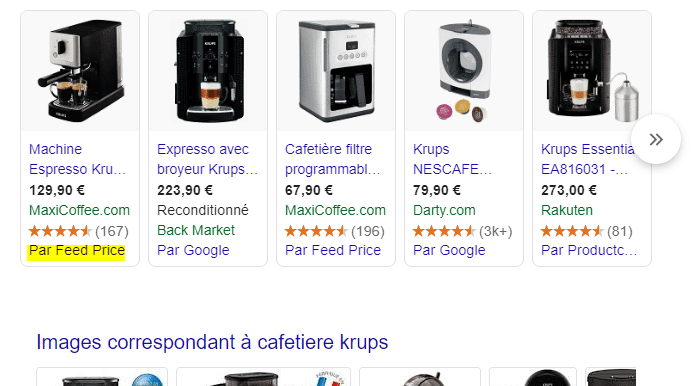
This traditional Shopping ad format makes it possible to redirect users to a specific product. Operating on a cost-per-click (CPC) basis, the platform only charges you when users click on your ad. When using a CSS, its name appears below your Google Shopping ad. Clicking on the CSS name is free and redirects the user to a landing page on the price comparison website.
 2. Google Showcase Ads
 2. Google Showcase Ads
This type of Google Shopping ad gives you the option to present several products to users. When they click on it, they access a gallery of products that you have selected in advance. This format is charged on a cost-per-engagement (CPE) basis, meaning Google Ads only charges you when a user expands the ad and browses it for at least 10 seconds. However, if the user clicks on one of the products shown in your gallery, the cost-per-click (CPC) model is applied instead.
3. Google Local Inventory Ads (Google LIA)
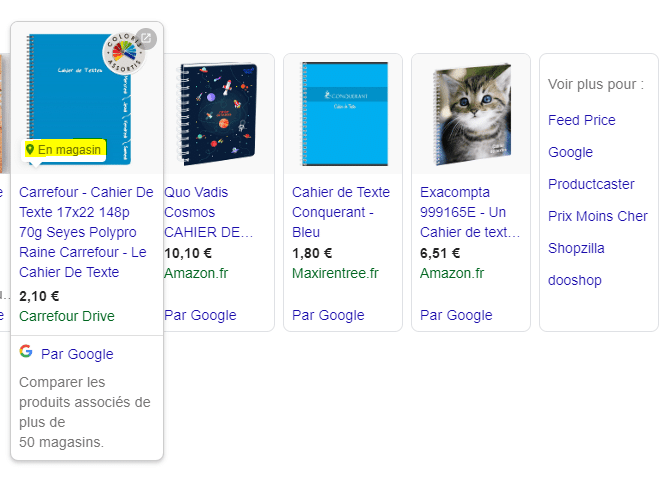
This campaign category allows you to show your available stock (online and offline) to users located near your store and provide them with all the information that may be useful (your address, opening hours, etc.). Google LIA is particularly popular with advertisers because it helps them promote their physical stores online and offer more options to increasingly demanding modern consumers. This type of Google Shopping ad is charged on a cost-per-engagement (CPE) basis, depending on the number of times a user scrolls through or clicks on the ad, or on a cost-per-click (CPC) basis depending on the redirect format.
Why should you choose Feed Price, Labelium Group’s CSS, for your Google Shopping campaigns?
In July 2018, Feed Manager, a web marketing agency belonging to Labelium Group, launched its own price comparison service (CSS), “Feed Price”. But what are its advantages?
After obtaining Google CSS Partner certification, more than 100 European merchants decided to place their trust in us. Our CSS allows them to:
- Buy clicks 20% cheaper than through Google Ads.
- Avoid paying unnecessary fees: we only charge our clients reduced technical fees for access to our Feed Price SCP.
- Manage Shopping campaigns in Google Ads easily while spending less money.
- Benefit from the expertise of Feed Manager professionals: our consultants work tirelessly to stay up to date and keep track of the latest trends in digital marketing, e-commerce, acquisition and marketplaces.