Facebook limits the number of ads displayed per page

At the beginning of September, Facebook confirmed the introduction of a limit on the number of ads that can run simultaneously from a Page on its platform. This control on ad volume, which will apply from February 16, 2021 and continue through the summer, is presented as a measure aimed at helping advertisers reduce costs and improve the performance of their ads. We explain why and what the implications are.
What Is the Benefit of Limiting Ads on Facebook?
Before the introduction of today’s machine learning-based advertising formats, advertisers on Facebook had to create a large number of ads in order to personalize their advertising and thereby hope to reach their target audience. Today, new advertising products, benefiting from this machine learning and available on the platform, allow them to improve their performance while reducing the volume of ads they need to manage. These include, for example, dynamic ads that can integrate an advertiser’s entire product catalog into a single ad and select the most relevant products to show to each user.
What had until now been a recommendation from the social network will therefore become mandatory next year because, as Facebook explains, a high volume of ads is by no means synonymous with high performance. On the contrary, running a large number of ads simultaneously means that each one is displayed less frequently and, consequently, insufficient data is collected for the algorithm to learn from and optimize their delivery. As a result, four out of ten ads reportedly fail to exit the machine learning phase. A large portion of the allocated budget is therefore spent before the system has even been able to improve performance.
The Implications of This Decision for Advertisers
As advertisers, you need to understand the impact this measure will have on the management of your Page in order to be ready for February 2021 and ensure the continuity of your advertising campaigns.
Which Ads Will Be Affected by This Restriction?
This measure, which will apply per Page rather than per ad account, will take into account all active ads or ads under review when it is implemented, regardless of which account published them. Scheduled ads, on the other hand, will not be counted until they start running.
To find out when this restriction will take effect for your Page, Facebook invites you to consult its Page Manager.
What Will Be the Maximum Number of Ads Allowed per Page?
Will the number of ads allowed be the same for all advertisers, regardless of their size? No, the number of ads you will be able to run will depend on your advertising budget from the previous year, more specifically on the month in which you spent the most over the previous 12 months. This figure may range from 250 to a maximum of 20,000 ads, as shown in the table published by Facebook.
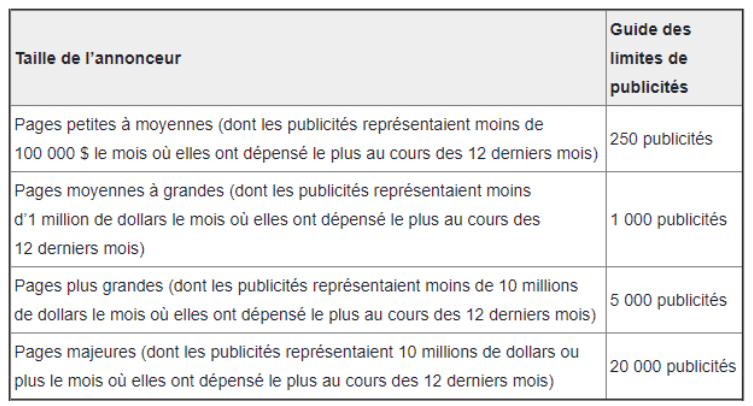
Guide to ad limits based on advertiser size published by Facebook
By accessing the Ad Limits Per Page tool, available through the Business Manager menu, you can view the maximum number of ads that would be imposed for each of your Pages if the limit were to take effect today.
If, when this measure is introduced, your Page exceeds the authorized limit, you will be unable to run new ads or modify existing ones. You will therefore need to remove some of them in order to reduce your ad volume below the established limit. However, note that all ads (dynamic content, automatic placements, or dynamic ads) will be counted as a single ad, even if they contain multiple pieces of advertising content.
Finally, if several accounts or users create ads for the same Page, Facebook explains that its administrator will be able to set additional limits for partners so that they do not prevent one another from running new ads.
Feed Manager’s View
To prepare for these changes and avoid any problems once these limits are introduced, we recommend applying what was already a best practice recommended by Facebook: reduce your ad volume now. To do this, simplify the structure of your accounts by grouping audiences into a smaller number of ad sets and limit the number of active ads in each of them.