Google’s 22nd Anniversary
Google is celebrating its 22nd anniversary this month. For the occasion, we first offer a retrospective of its history and how the American company developed, before finishing with a brief presentation of its various essential advertising products.
All tests are allowed and nothing is ever in vain: that is Google’s policy. Innovation is Google’s leitmotif, as the company constantly reinvents itself and reinforces its position as a global leader with more than 90% market share.
The History of Google’s Rise
In 1995, Larry Page and Sergey Brin, computer science students, met at Stanford University in the United States. One year later, they decided to create a search engine together to make the world’s information accessible to everyone. Named BackRub, it was initially hosted on the university’s servers. The two young partners had limited financial resources until one of their professors, David Cheriton, decided to invest $200,000 in the project. In 1998, Larry and Sergey met Andy Bechtolsheim, co-founder of Sun Microsystems, who invested $100,000 in the project, which had been renamed Google in 1997. On September 4, 1998, Google Inc. was created, and in August 1999, the partners established their famous Googleplex headquarters in Mountain View, California.
From then on, Google was no longer a beta research project, but a genuine search engine handling 3 million queries per day. It became increasingly popular around the world and continued to grow.
In August 2004, Google made its Wall Street debut with shares priced at $85. Its market capitalization was then valued at $50 billion.
In 2019, Larry Page and Sergey Brin announced their departure, leaving current CEO Sundar Pichai at the helm of the American giant, which at that time employed more than 85,000 people around the world.
Advertising Products Developed and Updates That Disrupted the Market
By diversifying its services, Google has managed to become indispensable. Here is a closer look at some of the products it has developed in recent years that we know well at Feed Manager and within the Labelium Group.
Drive to Store
Drive to Store aims to bring consumers to a physical point of sale. Many consumers check product availability or prices online before going to a store. Since these searches are mainly carried out on mobile phones, Google can use geolocation to direct potential buyers to nearby stores through Google Maps.
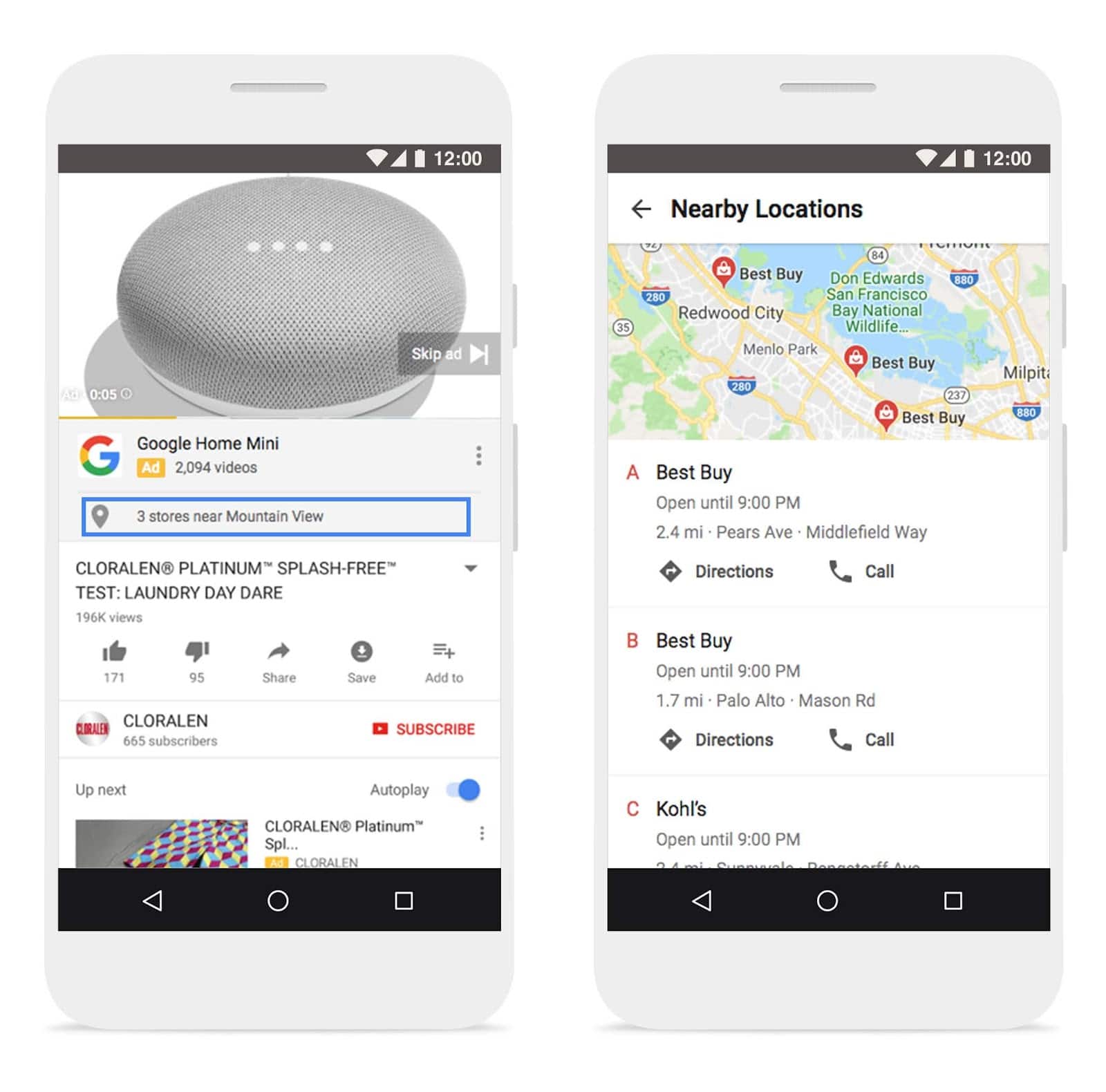
Example of Drive to Store using Google’s geolocation tool
Google My Business
The Google My Business tool allows businesses to improve their web presence by making it easier to update their online information directly from the search engine and Maps.
Even more widely used with COVID-19, Drive to Store and Google My Business have a promising future in terms of usage.
Google Shopping
The essential price comparison service Google Shopping gives e-commerce businesses the opportunity to pay for product listings in order to attract users to their website. However, Google launched a free version in the United States and India, which was due to arrive in France in mid-October. Free listings are gradually appearing below paid offers.
Until 2018, Google’s CSS (Comparison Shopping Services) had no competitors on Google Shopping, which led to a European Commission ruling against the company for abuse of a dominant position. Google has since opened its advertising space to other price comparison services and even offers them more advantageous rates. This only applies in countries belonging to the European Economic Area. Advertisers can therefore choose the CSS that best suits them in order to appear in Google search results.
Google Shopping Actions
Google Shopping Actions allows merchants who meet certain criteria to present their products across different Google platforms. Available in the United States and France, it allows merchants to increase the visibility of their products and attract new customers. There is no monthly subscription; merchants only pay a commission when a sale is completed. Customers, meanwhile, can quickly and securely purchase what interests them without having to leave Google’s platform.
Google Panda
Recent years have also been marked by major updates, including the most important one, which significantly disrupted the market: Google Panda. Launched in 2011, it is a filter within Google’s algorithm that combats websites offering low-quality content by penalizing them. The market continues to evolve in this direction with data protection, new GDPR regulations, and the upcoming removal of third-party cookies.
Of course, among the major essential products developed by the Mountain View company, we can also mention YouTube, Gmail, Google Books, Google Earth, Google Apps and Chrome, Android, Google +, Google Ads…
Although Google, the world’s most widely used search engine, already dominates several markets, it is far from stopping there. With Google Shopping Actions, it aims to compete with online retail giant Amazon by offering the best possible service to merchants and customers. Competition is fierce, and each company is trying to expand a little further: Amazon is moving toward becoming a search engine, while Google is moving toward becoming a marketplace.
Google has come a long way since its creation, but it still has plenty of surprises and new products in store that will shake up the rules of the market.

Google celebrates its 22nd anniversary!